Ninety Seconds at Noon
Reflections on the Angelus

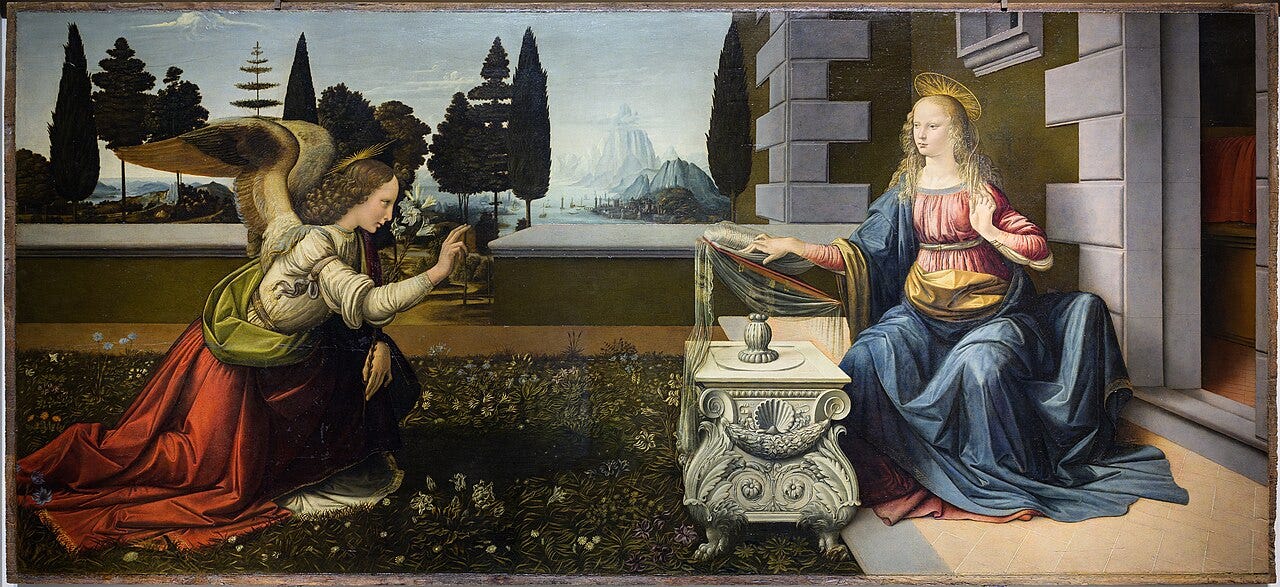
℣ The Angel of the Lord declared to Mary:
℟ And she conceived of the Holy Spirit.
Hail Mary...
℣ Behold the handmaid of the Lord:
℟ Be it done unto me according to Thy word.
Hail Mary...
℣ And the Word was made Flesh:
℟ And dwelt among us.
Hail Mary...
℣ Pray for us, O Holy Mother of God,
℟ that we may be made worthy of the promises of Christ.
Let us pray:
Pour forth, we beseech Thee, O Lord, Thy grace into our hearts; that we, to whom the Incarnation of Christ, Thy Son, was made known by the message of an angel, may by His Passion and Cross be brought to the glory of His Resurrection, through the same Christ Our Lord.
Amen.
One of my most beloved Catholic devotions is to pray the Angelus at noon. The Church, in her wisdom, teaches us to pause in the middle of our day, just at the time we may be taking a rest from our labors, and ponder the Incarnation of God. It doesn’t take long; the entire prayer is easily said in ninety seconds (yes, I just timed it). This “easy yoke” and “light burden” contains, however, powerful spiritual insight. I highly recommend the practice.
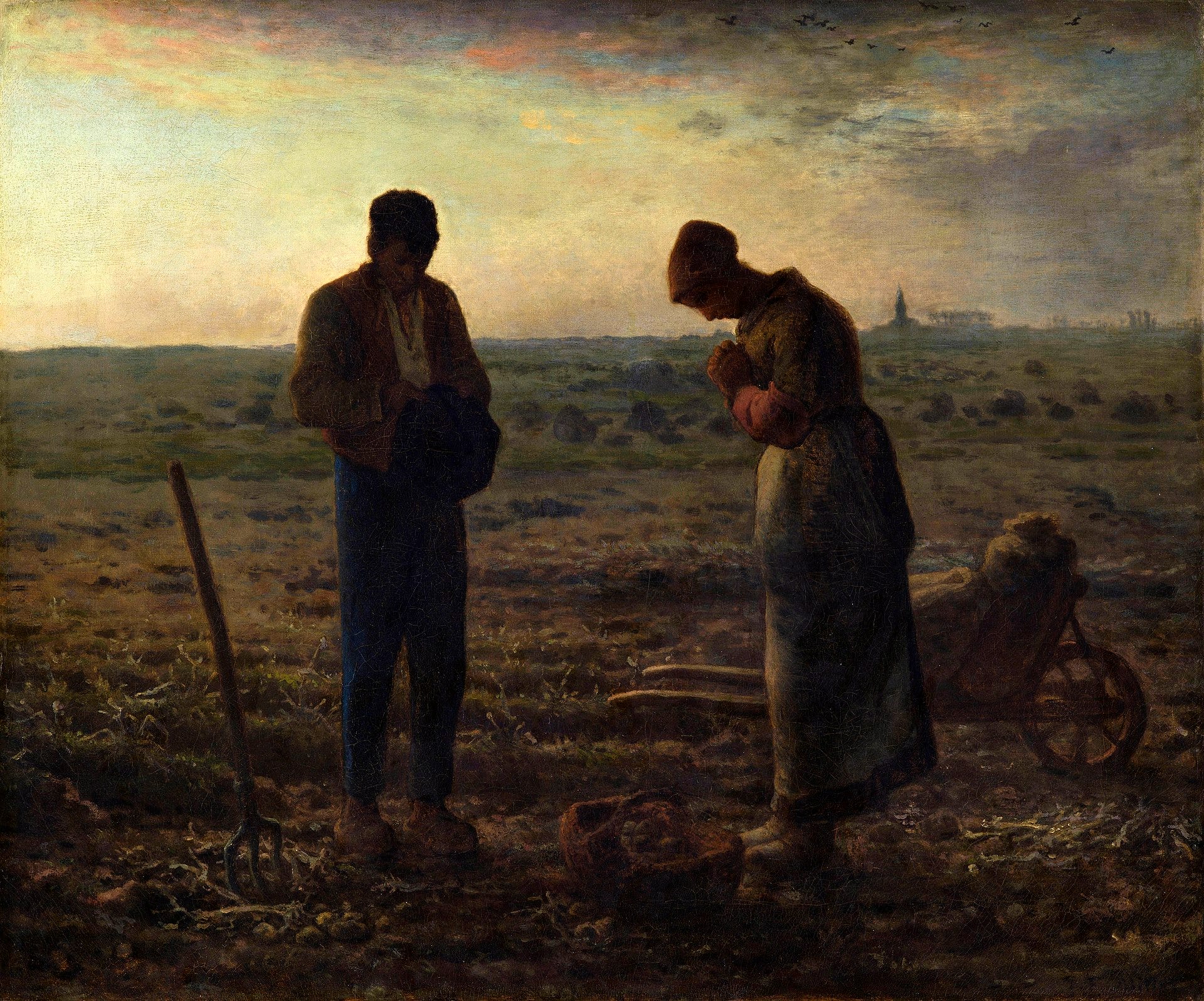
This prayer is a catechism of the Church’s teachings on creation, grace, salvation — and, of course, Mary. God acts. Mary receives. Immanuel is born. Mankind is redeemed.
God’s word is spoken through an angel. Mary’s word responds in faith. The Word becomes flesh and dwells among us.
God offers revelation and grace. Mary offers participation and prayer. We offer ourselves to the spoken and incarnate Word to receive the promised glory.
The prayer is unapologetically Marian. But so is the gospel. There is something intrinsically Marian about Jesus: after all, if God didn’t need a human father to become man, he didn’t need a human mother either. A God able to form a baby in a virgin womb can easily form a man without parents at all. But God chose to be “born of a woman” (Gal. 4:4), this woman, Mary, whose irreducible role in the Christian life remains forever: to bring Christ to his people, and bring the people to Christ.
In the Angelus prayer we stand in wonder before God’s greatest creative act: the union of uncreated nature with created nature, the Eternal Word taking human flesh within the womb of the Blessed Virgin. It begins with God’s creative speech, just as all history begins. But something new is present: unlike the mindless matter of the first creation, here at the second creation is another mind — a human mind, full of grace, responding in humility and faith.
What is the result? Something new! — creation transformed by its union with divinity, virginity made fruitful, a Man who is also God.
The final petition of the Angelus is for this grace, which so overflowed the Virgin Mary that it produced Divinity, to be poured into our hearts as well; that we too may hear the Word she heard, bear the Word she bore, and receive the glory of her Son.
Thus every day the Church invites us to pause and ponder the greatest work of God. We journey with Mary through the plan of salvation, and we genuflect with awe and love when we speak the most glorious words possible for human speech: And the Word became flesh, and dwelt among us.